



Robotic vs. Manual Mixer Drum Cleaning
Robotic vs. Manual Mixer Drum Cleaning: What Long Island Fleet Managers Should Know Before Choosing
Every fleet manager on Long Island eventually faces the same decision: how to handle hardened concrete buildup inside mixer drums.
The two paths are robotic vs. manual mixer drum cleaning. While manual cleaning has been the default for decades simply because it’s what most shops already know how to do, it’s worth putting both methods side by side before assuming the old way is still the cheaper way.
This isn’t a theoretical comparison. For a fleet running a dozen or more trucks between Nassau and Suffolk County, the method chosen for drum maintenance directly affects labor cost, truck downtime, drum lifespan, and—often overlooked—legal exposure.
Manual Drum Cleaning: The Traditional Method
Manual cleaning means a worker physically enters the mixer drum with a jackhammer, air chisel, or similar tool and chips away hardened concrete by hand.
It’s the method most fleets grew up with, and it works—but it comes with real downsides that tend to get absorbed quietly into operating costs rather than tracked as a single line item.
Costs and Risks of Manual Cleaning
- Confined-space entry—requires a trained crew, safety monitoring, and ventilation procedures every time.
- Labor-intensive—typically needs multiple workers and hours per drum, not minutes.
- Inconsistent results—quality depends heavily on the individual operator.
- Drum damage risk—repeated jackhammer impact can crack or warp the drum’s steel structure over time.
- Extended downtime—a truck can be out of rotation for a full shift or more per cleaning cycle.
Robotic Drum Cleaning: The Newer Standard
Robotic drum cleaning systems use high-pressure water blasting—hydrodemolition—controlled remotely by a single operator standing outside the drum.
No one climbs inside. The water pressure alone breaks down the hardened concrete, and the debris is flushed out rather than chipped out.
What Changes with a Robotic System
- No confined-space entry—the operator never goes into the drum.
- Single operator—no multi-person crew required for the cleaning cycle itself.
- Faster cycle time—roughly 500 kg of hardened concrete removed in about 75 minutes.
- Gentler on the drum—controlled water pressure instead of repeated metal-on-metal impact.
- Consistent results—the process doesn’t depend on one worker’s technique or fatigue level.
Side-by-Side: What Actually Matters to Your Bottom Line
| Factor | Manual Cleaning | Robotic Cleaning |
|---|---|---|
| Crew Required | Multiple workers | Single operator |
| Confined-Space Entry | Required | Not required |
| Typical Cycle Time | Extended and variable | ~75 minutes for ~500 kg |
| Risk to Drum Structure | Higher (impact damage) | Lower (controlled water blasting) |
| Consistency | Depends on operator | Standardized process |
| Safety Exposure | Confined-space hazards | Operator stays outside the drum |
The manual method isn’t wrong—plenty of Long Island fleets still run it successfully. But as fleet size grows, the hidden costs of labor hours, drum wear, and downtime start to outweigh the lower upfront investment in tools.
Why This Decision Matters More As Your Fleet Grows
A single truck cleaned manually once in a while is a manageable task. A fleet of fifteen or twenty trucks needing regular drum maintenance is a different equation entirely.
At that scale, the labor hours, the downtime per truck, and the accumulated wear on drums from repeated manual chipping start to add up to a real, recurring operating cost—one that a robotic system is specifically designed to reduce.
There’s also a safety and compliance angle. Confined-space work carries inherent risk regardless of how careful a crew is, and fleet managers are increasingly looking for ways to reduce that exposure without slowing down operations. A robotic system removes the confined-space element from the equation entirely, which simplifies both safety planning and liability exposure.
Making the Switch
For fleets ready to move away from manual cleaning, the practical question becomes equipment access—buying new, renting, or finding a well-maintained used unit.
A low-hour used system can make the switch financially realistic without the wait or cost of a new build.
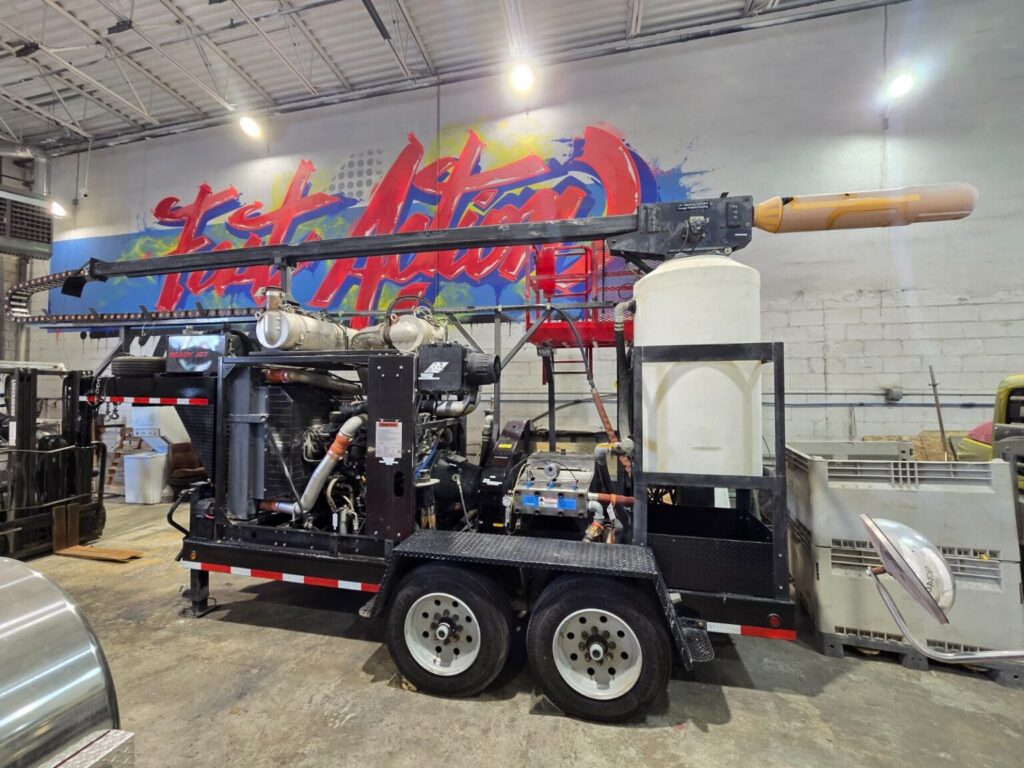
That’s the situation with the 2021 ReadyJet G3 currently for sale—a robotic hydrodemolition system with only 412 operating hours, fully operational, and ready to go to work immediately.
For a deeper look at how buildup itself affects fuel and payload, see our breakdown on concrete mixer drum cleaning for Long Island fleets.
If you’re weighing robotic vs. manual mixer drum cleaning for your own fleet, call 718-558-4111 to talk through the numbers or schedule an inspection of the unit currently available in Far Rockaway, NY.
Frequently Asked Questions
Which method is faster, robotic or manual drum cleaning?
Robotic cleaning is generally faster and more consistent — a system like the ReadyJet G3 removes about 500 kg of buildup in roughly 75 minutes, without the variability of manual technique.
Does robotic drum cleaning damage the mixer drum?
No. Controlled water blasting is gentler on the drum’s steel structure than repeated jackhammer or chisel impact, which can crack or warp the drum over time.
How many workers are needed for manual drum cleaning vs. robotic?
Manual cleaning typically requires a multi-person crew for confined-space entry procedures, while a robotic system is run by a single operator from outside the drum.
Is robotic drum cleaning more expensive than manual?
The upfront equipment cost is higher, but manual cleaning carries ongoing labor, downtime, and drum-repair costs that often outweigh that difference over time.
Can a robotic system clean drums as thoroughly as manual chipping?
Yes. High-pressure water blasting breaks down hardened concrete effectively and consistently, without depending on one worker’s technique.
What training is required to operate a robotic drum cleaning system?
Operators are trained on the system’s remote controls rather than confined-space entry procedures, since no one enters the drum during cleaning.
How do I know which method is right for my fleet?
It generally comes down to fleet size and cleaning frequency — smaller, occasional needs may still suit manual cleaning, while larger or more frequent needs tend to favor a robotic system. Call 718-558-4111 to talk through your specific situation.
Contact Us
Follow Us


