



Concrete mixer drum cleaning Long Island
How Ready-Mix Fleets on Long Island Can Cut Fuel Costs by Removing Hardened Concrete Buildup
If you manage a mixer truck fleet in Nassau or Suffolk County, you already know the routine: trucks go out, drums get partially cleaned between loads, and over months — sometimes years — a layer of hardened concrete builds up inside every drum. Most fleet managers treat it as background noise. It shouldn’t be. Concrete mixer drum cleaning on Long Island is one of the few maintenance items that pays for itself directly, every single day, in fuel and payload — and most operations are leaving that money on the table.
Long Island runs one of the densest concentrations of ready-mix concrete producers in the New York metro area, from large multi-plant operators to smaller family-owned yards serving Nassau and Suffolk. With that many trucks on the road daily, even a small amount of dead weight per drum adds up to a real number across a fleet by the end of the year.
The Hidden Cost of Hardened Concrete Buildup
Every kilogram of hardened concrete stuck inside a mixer drum is weight the truck carries on every trip — loaded or empty, delivering concrete or heading back to the plant. That buildup does three things to your bottom line:
- It reduces usable drum capacity. Less room for fresh concrete means more trips to deliver the same volume.
- It increases fuel consumption. Dead weight doesn’t discriminate — the engine burns fuel to move it whether it’s product or buildup.
- It accelerates wear on the drum itself. Buildup left untreated hardens further, making it more likely that aggressive removal methods (jackhammers, chisels) will be needed later — methods that risk cracking or warping the drum wall.
None of this shows up as a single line item on a maintenance report. It shows up gradually, in fuel bills that creep up and payload numbers that quietly shrink — which is exactly why it gets ignored until it’s a bigger, more expensive problem.
Why Manual Drum Cleaning Isn’t the Answer Long-Term
The traditional fix — sending a worker into the drum with a jackhammer or air chisel — comes with real costs beyond labor hours. It requires confined-space entry procedures, exposes workers to a genuinely hazardous environment, and the repeated impact of manual chipping tools puts direct stress on the drum’s steel structure. Fleet managers on Long Island who’ve dealt with a cracked or warped drum after aggressive manual cleaning know it’s not a cheap mistake to fix.
There’s also the downtime factor. Manual cleaning is slow, inconsistent between operators, and pulls a truck out of rotation for longer than most schedules can comfortably absorb — especially during peak pour season.
The Robotic Alternative: Hydrodemolition Without Confined-Space Entry
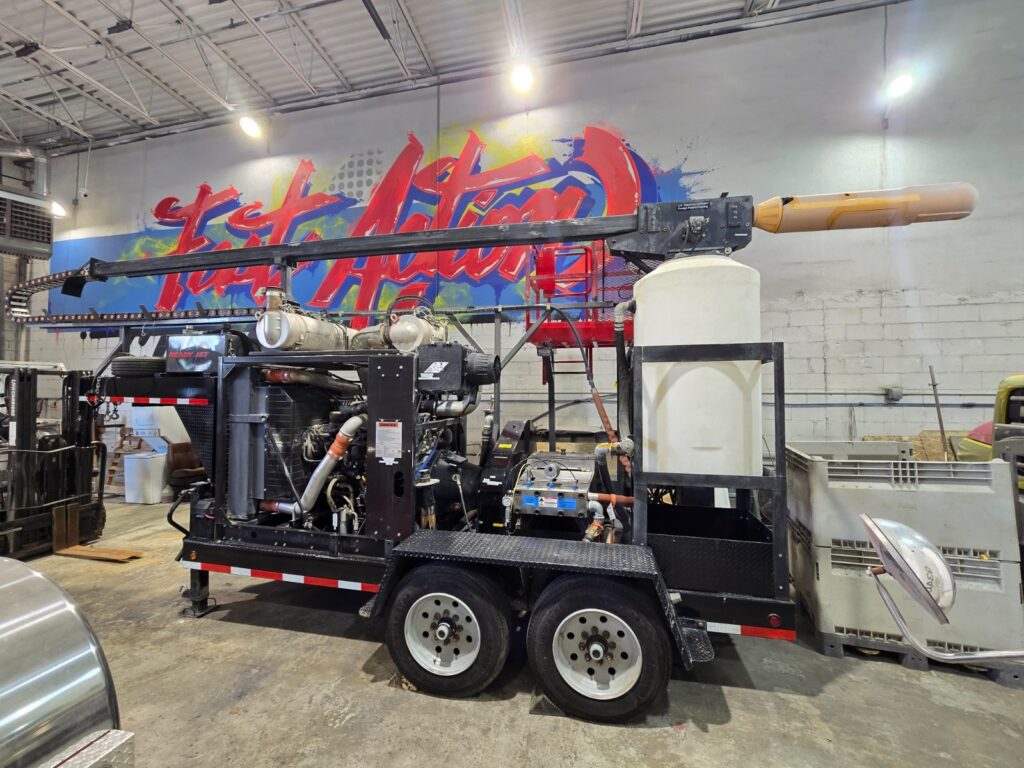
Robotic mixer drum cleaning systems solve this differently. Using high-pressure water blasting — in some systems reaching 20,000 PSI — a single operator can strip hardened concrete from inside a drum while staying completely outside of it. No confined-space entry, no jackhammer impact on the drum wall, and a process that’s consistent every time regardless of who’s running it.
For a mid-size Long Island fleet, that translates into:
- A single operator handling drum cleaning instead of a multi-person confined-space crew
- Roughly 500 kg of hardened concrete removed in about 75 minutes per cycle
- Restored drum capacity and lower per-load fuel burn across every truck cleaned
- A cleaning method that doesn’t put the drum itself at risk
What This Means for Nassau and Suffolk County Fleets
If your operation runs more than a handful of mixer trucks, the math tends to favor bringing drum cleaning capability in-house rather than relying on occasional outside service calls — especially given how spread out plants are across Long Island and how much a truck sitting idle costs per day it’s out of rotation.
This is exactly the gap a system like the ReadyJet G3 fills: a low-hour, fully operational robotic hydrodemolition unit that a Long Island fleet or drum-cleaning contractor can put to work immediately, without waiting on a new-build order. It’s currently available out of Far Rockaway, NY — close enough to Nassau and Suffolk County operations to make inspection and pickup straightforward.
A Maintenance Item Worth Reassessing
Concrete mixer drum cleaning on Long Island doesn’t need to stay a low-priority task handled reactively once a drum is nearly full. Treated as a regular maintenance cycle — with the right equipment — it becomes a direct lever on fuel cost, payload capacity, and drum longevity across an entire fleet.
According to the National Ready Mixed Concrete Association, proper fleet maintenance practices are a core part of managing operating costs for ready-mix producers of any size — and drum condition is very much part of that equation.
If you’re evaluating what it would take to bring robotic drum cleaning in-house, take a look at the specifications and condition report on the 2021 ReadyJet G3 currently for sale, or call 718-558-4111 to ask about scheduling an inspection.
Frequently Asked Questions
How often should ready-mix trucks have their mixer drums cleaned?
It depends on usage, but most active fleets benefit from a regular cleaning schedule rather than waiting until buildup becomes severe — the longer buildup sits, the harder and more expensive it is to remove.
How much fuel can a fleet save by removing hardened concrete buildup?
Savings vary by fleet size and buildup severity, but less dead weight per truck generally means lower fuel burn across every load, every trip.
How much weight does hardened concrete buildup typically add to a mixer drum?
Buildup accumulates gradually over months or years, and the exact weight depends on how long a drum has gone without cleaning.
Is robotic drum cleaning suitable for older mixer trucks?
Yes. The cleaning process works on the hardened concrete inside the drum and isn’t dependent on the age of the truck itself.
How long does a robotic drum cleaning cycle take?
A robotic system like the ReadyJet G3 can remove roughly 500 kg of hardened concrete in about 75 minutes.
Does removing concrete buildup increase how much a truck can carry?
Yes. Restoring usable drum capacity means more room for fresh concrete on each load.
Where can Long Island fleets get a robotic drum cleaning system?
A low-hour used unit, like the ReadyJet G3 currently for sale in Far Rockaway, NY, is one option for fleets that want to bring this capability in-house without the cost of a new build.
Contact Us
Follow Us


